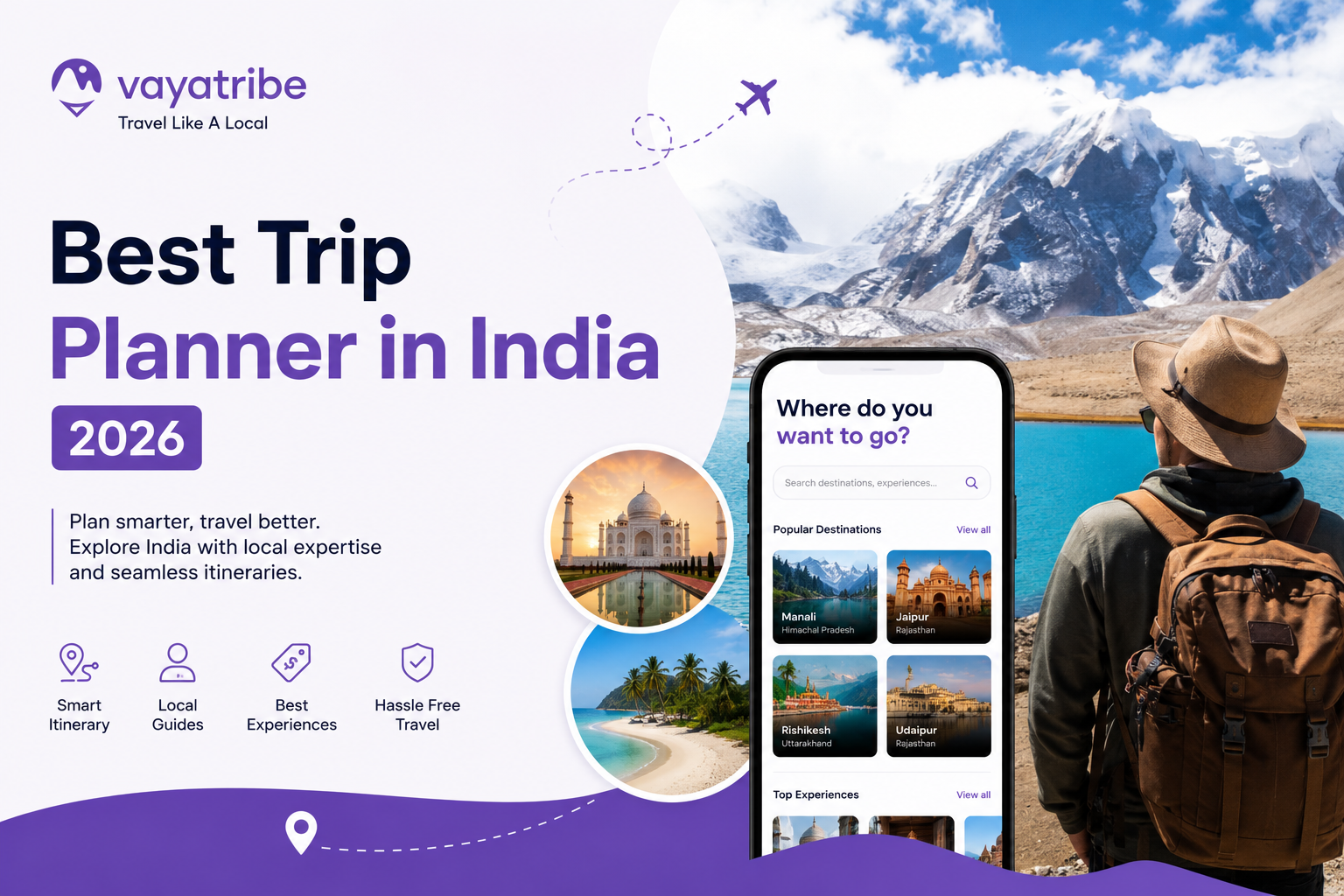
Type “trip planner” into Google right now and you’ll get a wall of apps promising to build your dream itinerary in sixty seconds. Drag-and-drop maps. AI chatbots that spit out a day-by-day schedule before you’ve finished your coffee. It all looks impressive — until you land in Delhi, your driver is nowhere to be found, the temple you planned around closed for a festival nobody mentioned, and the “10-minute” auto-rickshaw ride to your hotel somehow eats your entire afternoon.
That’s the moment every traveler learns the same lesson: India doesn’t run on algorithms. It runs on people, timing, relationships, and a kind of local knowledge no app has ever managed to scrape.
So if you’re planning a trip to India in 2026, here’s the honest, no-fluff guide to actually getting it right — including where technology helps, where it quietly fails you, and why the smartest travelers this year are skipping the generic itinerary planner altogether in favor of something better: a real local trip planner who’s already walking those streets.
Let’s give credit where it’s due. Apps like Wanderlog, Google’s travel tools, and AI trip planners like ChatGPT are genuinely useful — for the first 20% of the job.
Where they shine:
Where they fall apart: An AI trip planner can tell you the Taj Mahal is open Tuesday through Sunday. It cannot tell you that the ticket counter closes an hour before the monument does, that the “skip the line” guide outside is unlicensed, or that the best light for photos is 45 minutes after sunrise — not the 9 a.m. slot your app suggested.
Digital planners are built on static data. India runs on live, human, day-of information — festival closures, monsoon-flooded roads, sudden train delays, strikes, and a hundred small local realities that never make it into an app’s database.
This is the part most travel blogs skip, because it doesn’t come with a slick app screenshot. But it’s the actual answer to “how do I plan a trip to India without getting overwhelmed, scammed, or exhausted?”
You hire a local trip planner. A real one.
For decades, this meant going through a traditional travel agency — expensive, impersonal, and often selling you a fixed package designed for their profit margin, not your interests. In 2026, that middleman is gone.
VayaTribe works differently: it’s a marketplace that connects you directly with verified, background-checked local guides across India — real people who live in the cities you’re visiting and turn your rough itinerary into a smooth, authentic, and safe reality.
Think of it as the missing layer between “I have an idea of where I want to go” and “I’m actually having the trip of a lifetime.”
| Challenge | What an App Does | What a VayaTribe Local Guide Does |
|---|---|---|
| Road closed for a festival | Reroutes you into gridlock | Knows the back lane that saves you two hours |
| Tout offering a “special price” | Nothing — it can’t see him | Steps in before you’re even approached |
| You want an authentic, non-touristy meal | Suggests the top-rated restaurant on the app (usually the most touristy one) | Takes you to the family-run dhaba that doesn’t have a Google listing |
| Sunrise photo spot behind the Taj Mahal | Doesn’t know it exists | Has been there a hundred times |
| Negotiating a fair boat ride in Varanasi | Can’t negotiate anything | Handles it before you even ask |
This is the gap VayaTribe was built to close — not by replacing your planning, but by putting a trustworthy human at the execution stage, where apps have always struggled the most.
Whether you’re using VayaTribe, a travel agent, or planning solo, these three rules should shape every itinerary you build.
Whatever your itinerary planner or AI tool tells you is possible in a day — cut it in half. India rewards slowness. Four monuments in one day sounds efficient on paper and feels like a punishment in 40°C heat. Plan two meaningful experiences per day and leave room for the unplanned detour, because in India, the detour is often the best part of the trip.
India’s Vande Bharat express network has transformed domestic travel, but seats on popular routes vanish weeks in advance. A smart trip planner locks down transport first, accommodation second, and daily activities last — not the other way around.
Don’t gamble on finding a good guide outside the monument gate. Those guides are frequently unlicensed and paid on commission to steer you toward specific shops. Instead, use a platform like VayaTribe to browse verified guide profiles, read reviews from real travelers, and book your local trip planner weeks before you even pack your bags.
There’s a reason “best AI trip planner 2026” is trending as a search term: travelers are exhausted by fifty open browser tabs, conflicting blog advice, and the sheer decision fatigue of planning a trip alone. AI tools promise to fix that overwhelm instantly.
And they do help with the overwhelm — for about the first draft. But a truly great trip isn’t just an efficient schedule. It’s the local guide in Jaipur who insists you try the impossible-to-find kachori stall his grandmother swears by. It’s the person in Varanasi who knows exactly which ghat to sit on at dusk. That layer of judgment, timing, and trust is something no model has replicated — and honestly, may never need to.
The winning strategy for 2026 isn’t “AI vs. human.” It’s AI for the sketch, human for the soul.
What is the best trip planner for a first-time trip to India? Start with a digital tool to rough out your route and budget, then bring in a verified local guide through a platform like VayaTribe to handle logistics, safety, and authentic experiences on the ground.
Are AI trip planners reliable for India specifically? They’re reliable for general research and route planning, but unreliable for real-time issues like festival closures, road conditions, scam avoidance, and last-minute changes — all common in India.
How far in advance should I book a local guide in India? At least 3–4 weeks before your trip, especially during peak season (October–March), so you can review guide profiles and confirm availability through VayaTribe rather than relying on guides found on the street.
Is VayaTribe only for guided tours, or can it fit into a self-planned itinerary? VayaTribe is designed to slot into a trip you’ve already sketched out. You bring the rough plan — the destinations and dates — and your matched local guide handles execution, logistics, and the experiences you’d never find on your own.
Stop drowning in spreadsheets, browser tabs, and generic AI-generated itineraries that read the same for every traveler.
The single most effective upgrade you can make to your India trip isn’t a new app — it’s a trustworthy local guide waiting for you when you land.